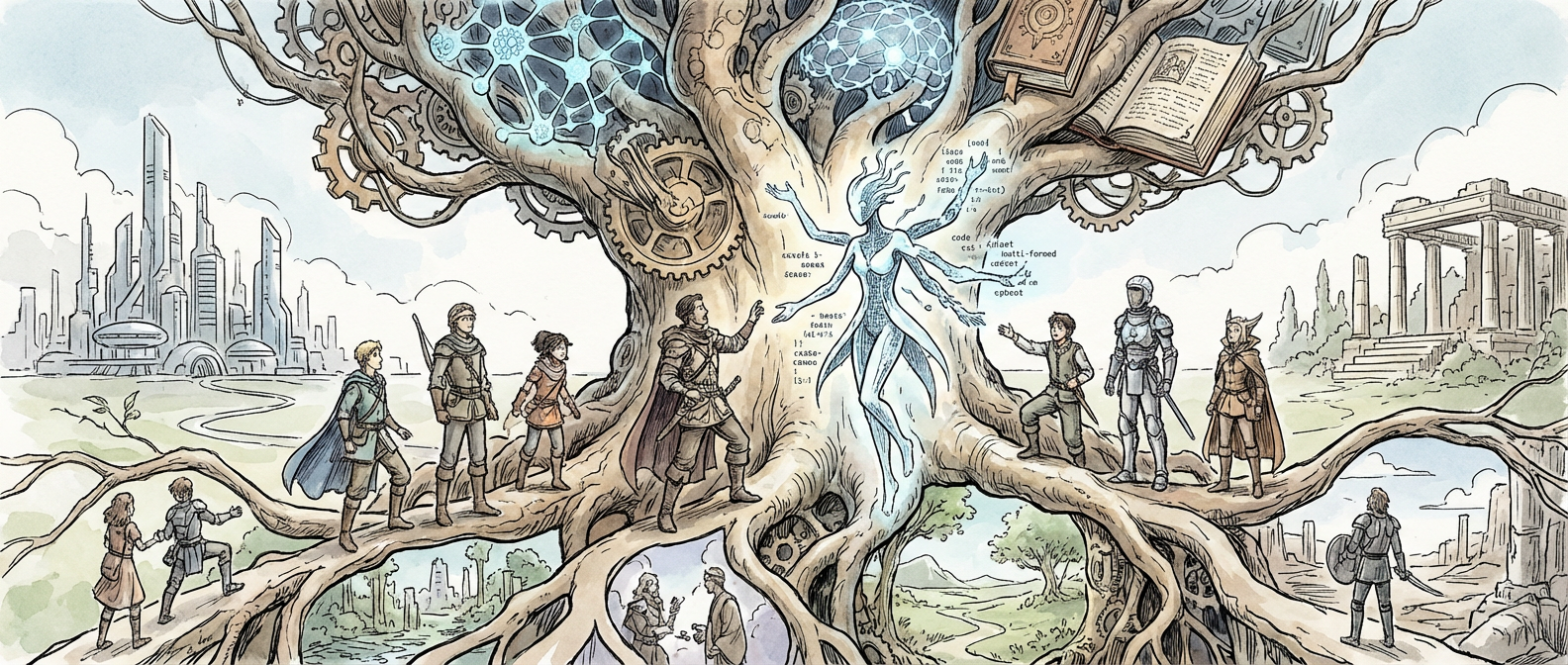
The Promise We Always Believed Was Coming
Remember when we first heard about truly interactive stories? Not the branching paths of choose-your-own-adventure books with their inevitable dead ends, not the limited dialogue trees of even the most ambitious RPGs, but something that could respond to anything you threw at it. We talked about it in gaming forums and dreamed about it during long D&D sessions that ran past midnight. The technology always seemed just around the corner, perpetually five years away.
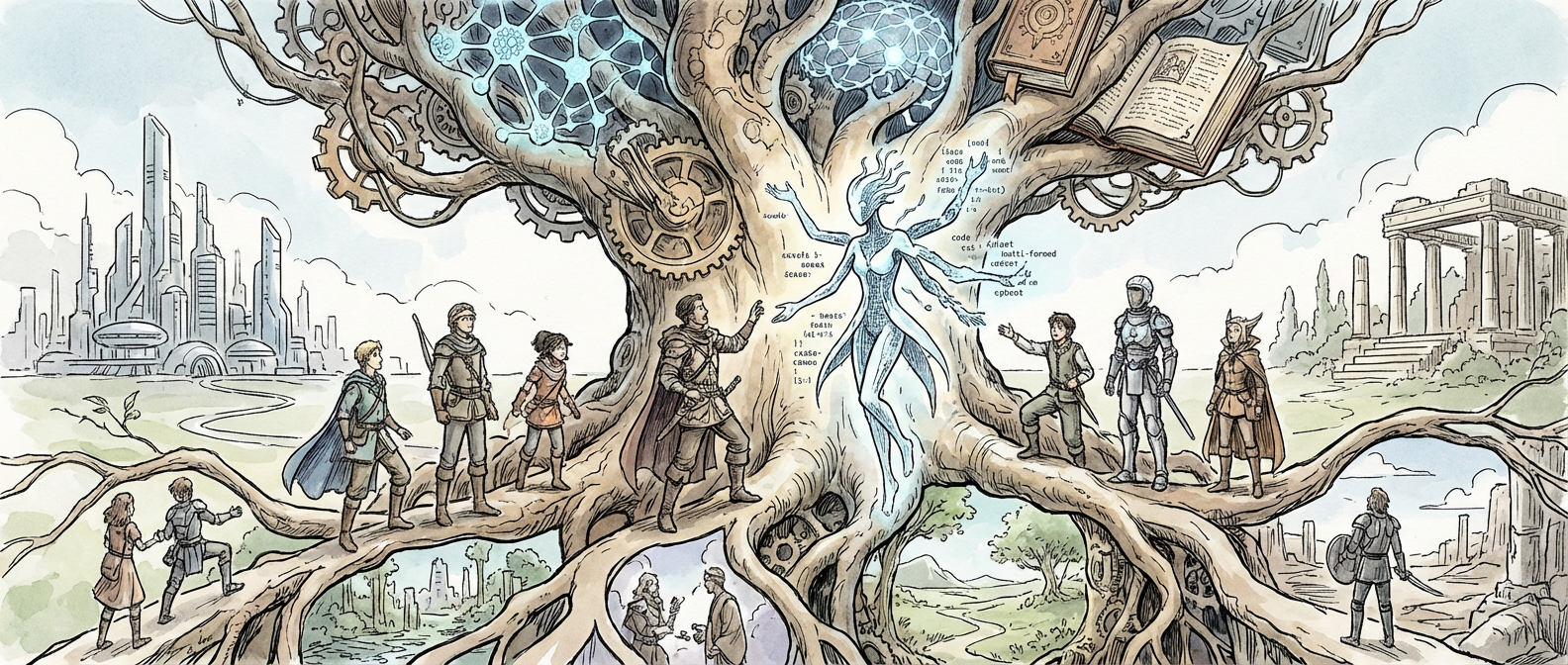
Then in 2019, something shifted. AI Dungeon arrived quietly, almost accidentally, and suddenly that dream felt real. Built on OpenAI’s GPT-2 language model, it promised infinite possibilities in text-based adventure gaming. Within months, two million users were typing commands into a simple web interface, watching artificial intelligence spin their wildest scenarios into stories that actually made sense. The interface was crude, the responses sometimes weird, but the core promise held true. You could type anything, and the game would try to make sense of it.
Looking back, those early days feel both revolutionary and quaint. We were so amazed that the AI could maintain basic narrative coherence that we forgave its tendency to forget important plot points or suddenly introduce dragons into our carefully crafted detective stories. The technology was rough around the edges, but it was something we had never experienced before: a storytelling partner that never said no.
The Explosion of Possibility
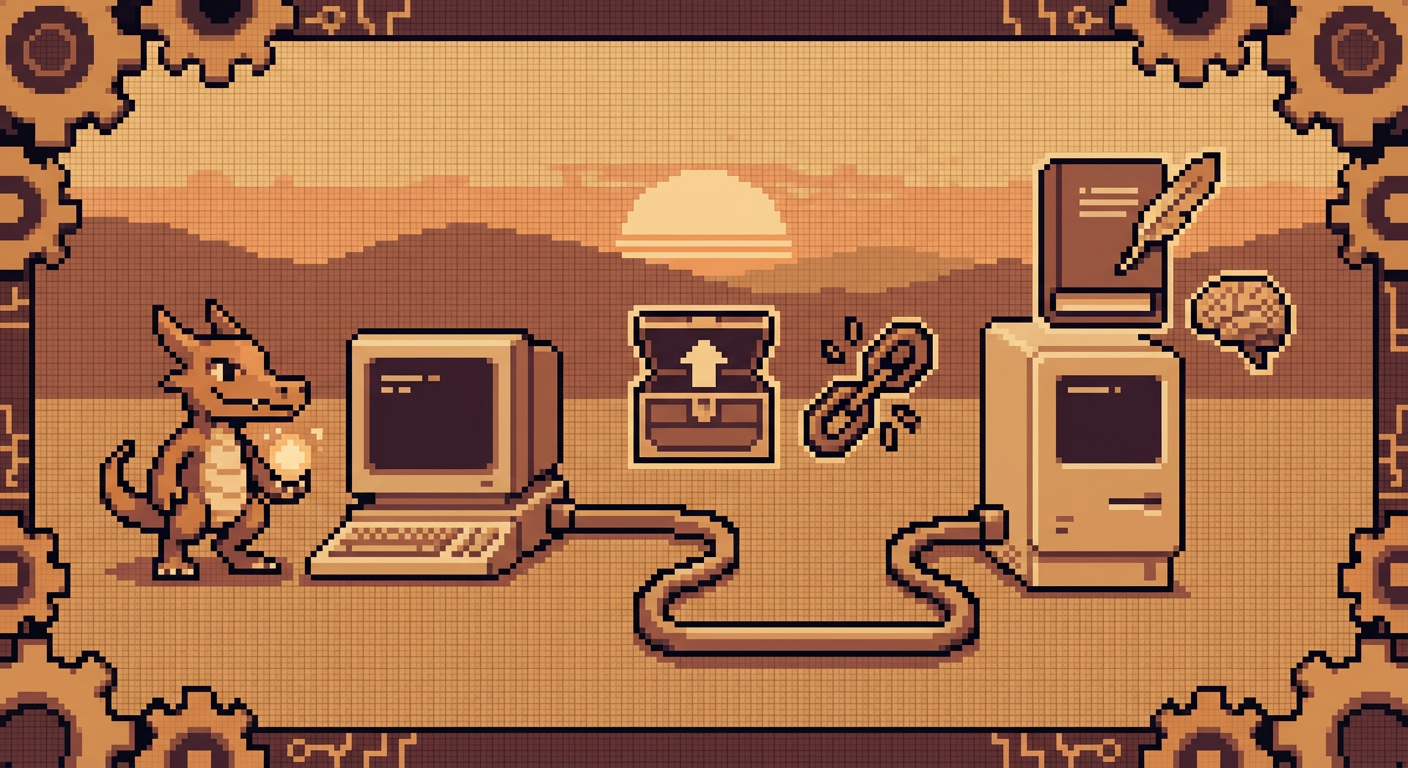
What followed was a renaissance of interactive fiction that few saw coming. AI Dungeon’s success proved that demand for AI-driven narrative experiences was massive, way beyond what traditional gaming companies had expected. Players were hungry for stories that could adapt not just to predetermined choices, but to their imagination itself.
This hunger created a whole ecosystem of alternatives. KoboldAI emerged for those who wanted to run AI models locally, giving players complete control over their storytelling experience without cloud-based limitations. NovelAI creative writing platform attracted users seeking more sophisticated narrative tools and fewer content restrictions. Each platform found its own audience, but all shared that same core promise: your story, unlimited by the boundaries of traditional game design.
The most surprising development came from Character.AI, which found enormous success not through traditional gaming channels but by focusing on roleplay and character interaction. With twenty million daily active users engaging primarily in conversational roleplay scenarios, it showed that the appetite for AI-driven interactive experiences went far beyond the traditional gaming audience. People wanted to talk to fictional characters, explore relationships, and inhabit stories in ways that went beyond combat and quests.
When the Table Went Digital
Maybe nowhere has the impact been more dramatic than in tabletop gaming communities. Solo tabletop RPG sessions, once a niche pursuit requiring elaborate journaling systems and random table consultations, suddenly became accessible through AI dungeon masters. Players could experience the collaborative storytelling aspect of tabletop RPGs without coordinating schedules or finding compatible groups.
These AI-assisted sessions revealed something important about what players actually wanted from interactive fiction. It wasn’t just about making choices or solving puzzles, but about having a conversation with a story. The best AI dungeon masters learned to ask questions, introduce unexpected complications, and yes, sometimes say no to player actions in ways that advanced the narrative rather than shutting it down.
Traditional tabletop RPG publishers took notice. Some embraced the technology, while others worried about AI replacing human dungeon masters entirely. The reality proved messier. AI became a tool for enhancing rather than replacing human creativity, helping solo players and overwhelmed game masters manage complex narratives and generate content on demand.
The Death and Rebirth of Branching Stories
The rise of AI-generated narratives also challenged the fundamental assumptions underlying visual novels and choose-your-own-adventure games. Why craft elaborate branching storylines when AI could generate infinite variations on demand? Traditional interactive fiction formats suddenly seemed constrained, their careful plotting and predetermined outcomes feeling artificial compared to the organic flow of AI-driven stories.
Yet this challenge also sparked innovation within traditional formats. Developers began experimenting with hybrid approaches, using AI to generate variations within carefully crafted narrative frameworks. Visual novels incorporated AI-generated dialogue to make characters feel more responsive. Choose-your-own-adventure games used AI to create unique paths between predetermined story beats.
The result wasn’t the death of traditional interactive fiction, but its evolution. The best new interactive narratives combined the coherent vision of human authors with the adaptability of AI systems. They used AI not as a replacement for storytelling craft, but as a new tool in the storyteller’s arsenal.
What We Lost and What We Gained
Looking back at this transformation, it’s worth acknowledging what we traded away for infinite possibility. The carefully crafted narrative arcs of traditional games, the satisfaction of uncovering author-intended secrets, the shared cultural experience of everyone playing through the same story. AI-driven narratives are inherently personal, creating unique experiences that can’t be easily shared or discussed with others.
There was also a learning curve that we underestimated. Effective AI roleplay requires different skills than traditional gaming. Players had to learn how to prompt AI systems effectively, how to guide narratives without breaking immersion, how to work with rather than against the AI’s tendencies. The technology democratized storytelling in some ways while creating new barriers in others.
But what we gained feels transformative. Stories that respond to player agency not through predetermined branches but through genuine adaptation. Characters that can engage in conversations beyond their scripted dialogue trees. Worlds that expand to accommodate player creativity rather than constraining it. These aren’t minor improvements to existing formats but fundamental shifts in what interactive fiction can be.
The future of interactive fiction will likely involve continued experimentation with the balance between human creativity and AI adaptability. As these technologies mature, the most interesting developments will probably come not from choosing sides but from finding new ways to combine the strengths of both approaches. What stories do you think are still waiting to be discovered in this new landscape of infinite possibility?